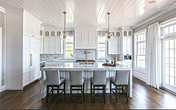
Merging the Home Office with Your Primary Living Space
The profound shift toward remote and hybrid work models has drastically blurred the lines between our professional and personal lives. For many, the central island has completely replaced the corporate cubicle, serving as a desk from nine to five and a dining table in the evening. However, trying to conduct a professional video call amidst the clutter of breakfast dishes is highly stressful. A strategic CT kitchen remodel acknowledges this new reality by intentionally designing a dual-purpose environment. By integrating hidden power solutions, establishing dedicated administrative zones, and managing acoustic privacy, homeowners can seamlessly blend high-level productivity with domestic comfort, creating a versatile space that perfectly supports the demands of the modern, work-from-home lifestyle.
Designing the Multi-Functional Co-Working Island
The central island is the undisputed hub of the modern home, and it must now be engineered to handle heavy administrative duties without compromising its culinary function. A multi-functional island requires specific spatial planning. One side must be strictly dedicated to food preparation, featuring the sink and chopping zones, while the opposite side is tailored for seated work. This requires a deeper overhang to provide ample legroom for comfortable, ergonomic seating during long meetings. Furthermore, the surface material must be considered; while heavily textured stone is beautiful, a smooth, matte quartz provides a much better surface for writing and using a computer mouse. This distinct zoning ensures that laptops and paperwork are kept safely away from splashing water and cooking oils.
Integrating Seamless Power and Connectivity
A critical failure point in many makeshift home offices is the chaotic tangle of charging cables stretching dangerously across walkways. A space designed for serious productivity must feature deeply integrated, seamless power solutions. During the renovation, multiple electrical outlets and high-speed USB-C charging ports should be flush-mounted directly into the sides of the island and beneath the overhang. For an even cleaner aesthetic, pop-up power grommets can be installed directly into the countertop, sitting completely flush when not in use and rising with a gentle push when a laptop needs power. Ensuring that robust, high-speed internet hardlines are routed to this central hub also guarantees stable, uninterrupted connections for crucial video conferences, eliminating the unreliability of standard residential Wi-Fi.
Creating Dedicated Administrative Drop Zones
When the workday ends, the physical reminders of work must be easily hidden to allow the homeowner to mentally transition back into personal time. Leaving laptops and ledgers on the counter ruins the relaxing atmosphere of the evening. A successful dual-purpose design incorporates a dedicated administrative "drop zone" or appliance garage. This is a specialised, shallow cabinet—often featuring a roll-down tambour door or retractable pocket doors—specifically designed to house office supplies, mail, and charging electronics. At five o'clock, the laptop, notebooks, and pens are simply slid into this cabinet, plugged into internal charging ports, and hidden behind a closed door. This immediate decluttering process instantly restores the room to a purely domestic, relaxing environment.
Optimising Lighting for Video Conferences
Standard overhead lighting that looks beautiful during a dinner party is often highly unflattering and harsh on a professional video call, casting deep shadows over the face. A workspace requires a highly adaptable, layered lighting strategy. To look professional on camera, the seated work zone needs soft, diffused, front-facing illumination. This can be achieved by installing adjustable, dimmable pendant lights above the island with frosted glass shades, which provide a flattering, even glow without creating a harsh glare on the computer screen. Having these work-specific lights on an entirely separate circuit from the bright, cool-toned preparation lights allows the homeowner to instantly switch the atmosphere from a focused corporate environment to a warm, inviting dining space with ease.
Conclusion
Working from home should not mean compromising the beauty or functionality of your primary living areas. By intelligently integrating hidden power solutions, ergonomic seating, and dedicated storage for office equipment, a single room can flawlessly serve dual masters. This forward-thinking design approach completely eliminates the friction between professional duties and domestic life, resulting in a highly productive, deeply comfortable home environment.
Call to Action
Transform your home into the ultimate hybrid working and living space by consulting with our dual-purpose design experts today.
Visit: https://kitchentraditions.net/